

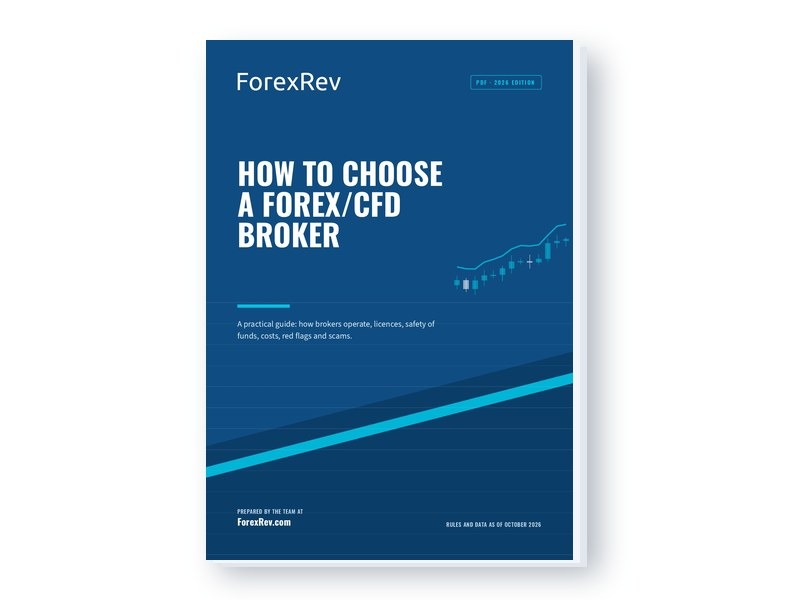
How to Choose a Forex/CFD Broker [eBook 2026]
A free ForexRev.com guide to choosing a Forex/CFD broker — 2026 edition, updated in October 2026. We explain how brokers work and make money, how to check a licence, what protects your money, how to compare costs and how to spot a scam.
Download the eBook [PDF, 31 pages] | [ePub]
The ePub file works on Kindle (via “Send to Kindle”), Kobo and PocketBook e-readers, and in Apple Books and Google Play Books.
The guide is written for traders at every level, from beginners to experienced. We do not recommend specific brokers in it — we do not even name them. Instead, we show the criteria worth using to choose a firm that fits you and your trading style, and the warning signs that should set alarm bells ringing.
Key points
- The licence comes first. Check the full name of the company you will contract with and find it in the regulator’s register (CySEC, FCA, BaFin, AMF…). Compare the domain and contact details — fraudsters impersonate licensed brokers. See also our warning list.
- In the EU, retail clients are protected: leverage of up to 30:1 on major currency pairs, mandatory negative balance protection, margin close-out at 50% and a ban on bonuses. A non-EU broker tempting you with higher leverage takes that protection away.
- Compensation schemes protect your money if a broker fails: in Cyprus the ICF up to EUR 20,000, in the UK the FSCS up to GBP 85,000, in every EU country at least EUR 20,000. Offshore brokers usually have none.
- The business model matters. A Market Maker may be the other side of your trade (a conflict of interest); an ECN/STP broker passes orders to liquidity providers and earns a commission. Check the model of the specific account, not of the whole firm.
- Count the total cost: spread + commission + swaps + fees for currency conversion, inactivity and withdrawals. “No commission” does not always mean cheaper.
- Red flags: unsolicited calls, guaranteed profits, requests to install AnyDesk or TeamViewer, crypto-only deposits, a “tax” before withdrawal, ads featuring famous people.
What is new in the 2026 edition
- current capital requirements for brokers (IFR/IFD in the EU, IFPR in the UK) and compensation scheme limits,
- permanent retail client protections following the ESMA intervention,
- crypto after 1 July 2026 — the MiCA regulation and the end of transitional periods,
- a new chapter on investment scams: deepfake ads, remote desktop software, fake platforms and fake “fund recovery”,
- prop firms and copy trading, a cost comparison example and a printable checklist.
Contents
- Introduction
- 1. The Forex/CFD market and the role of brokers — interbank, liquidity providers, what a CFD is, A-book, B-book and “toxic flow”
- 2. How brokers operate — Market Maker, ECN, STP, MTF, NDD, account types, CFDs or real shares and ETFs
- 3. Regulation and licences — the European passport and ESMA, retail client protections, professional clients, CySEC, FCA, other EU supervisors, ASIC, the US, offshore jurisdictions, MiCA, how to check a licence
- 4. Keeping your money safe — segregation of client funds, custodian bank, negative balance protection, compensation schemes
- 5. Trading costs — spread, commission, swaps, non-trading fees
- 6. Account, deposits and taxes — account currency, deposits and withdrawals, taxes
- 7. Platform, product range and service — platforms, instruments, execution and slippage, VPS, research, “account managers”, support in your language, reviews
- 8. Red flags
- 9. Investment scams — 2026 patterns — deepfakes, remote desktop, fake platforms, messenger groups, fake “fund recovery”, what to do after a scam
- 10. Prop firms and copy trading
- 11. How to choose the best broker for you — by experience, time horizon and trading style
- 12. Checklist before opening an account
- 13. Final tips
Download the eBook [PDF] | [ePub]
Once you know what you are looking for, compare brokers in our Forex broker ranking.
CFDs are complex instruments and come with a high risk of losing money rapidly due to leverage. Most retail investor accounts lose money when trading CFDs. This guide is for educational purposes only and does not constitute investment advice.