


Christine Lagarde to step down from ECB: EUR USD shifts on early succession plan
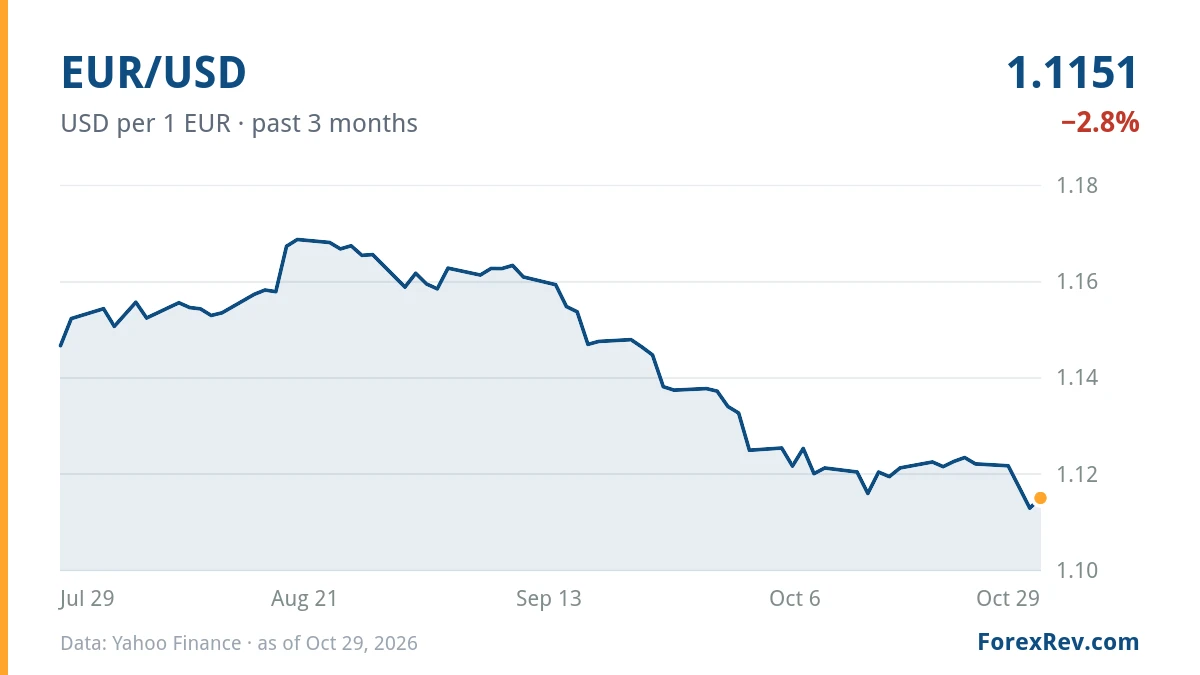
European Central Bank President Christine Lagarde will step down on 7 February 2027, ending her term nine months early. The unexpected announcement sets off an immediate leadership race across the eurozone, with EUR USD steadying near 1.1150 following the news.
⚡ Key numbers:
- 7 February 2027 – effective resignation date
- 9 months – early departure ahead of October 2027 mandate
- 16 of 21 states – required qualified majority in European Council
- 65% – minimum share of eurozone population needed for approval
- 1.1151 – EUR USD spot exchange rate
Early exit announced ahead of ECB rate decision
The European Central Bank announced on Thursday morning that Christine Lagarde will step down as its president on 7 February 2027. The governing council gave the 70-year-old French policymaker a standing ovation as policymakers met in Frankfurt to set interest rates across the 21-nation currency bloc. Lagarde has served as ECB chief since November 2019, when she succeeded Mario Draghi.
European Council President António Costa stated that the formal succession process would start immediately without undue delay. Outside Frankfurt, Lagarde has been widely discussed as a potential candidate to take leadership of the World Economic Forum, which gathers annually in Davos.
I have just informed my colleagues that I will step down as @ECB President on 7 February 2027.
It has been a source of great pride to serve this institution.
I thank all of those who have supported me on this journey over the past seven years. pic.twitter.com/eSLLTaDAej
— Christine Lagarde (@Lagarde) October 29, 2026
Succession timing and geopolitical considerations
By departing early, Lagarde enables European leaders to appoint her successor while French President Emmanuel Macron remains in office ahead of France's presidential election in April and May 2027. Holger Schmieding, chief economist at Berenberg, pointed out that this allows the European Union to secure institutional stability before potential political shifts in Paris.
Under EU rules, the European Council appoints the ECB president via a qualified majority requiring at least 16 out of 21 member states representing 65% of the eurozone's population. Frontrunners reported by international media include former Dutch central bank president Klaas Knot and former Bank of Spain governor Pablo Hernández de Cos, alongside Bundesbank President Joachim Nagel and EIB President Nadia Calviño.
“The European Union is trying to guard itself at least somewhat against the risk that rightwing Marine Le Pen may win the French presidential election in April/May 2027”
— Holger Schmieding, chief economist at Berenberg bank (via The Guardian)
Market response and currency dynamics
The leadership shift comes as the ECB continues to balance weak regional growth against its inflation mandate, targeting a return to target by late 2027. The sovereign debt market had already faced pressure, with the spread on French ten-year government bonds over German Bunds reaching levels unseen since 2011.
In foreign exchange markets, EUR USD traded slightly higher at 1.1151, advancing 0.19% after testing multi-month lows earlier in the week. Equity markets showed resilience, with Frankfurt's DAX gaining 1.05% to 25,975.
What to watch next
- European Council procedural steps and member state nominations
- ECB press conference comments regarding leadership continuity
- French-German sovereign bond spread developments
Frequently asked questions
When does Christine Lagarde officially step down?
Lagarde will step down on 7 February 2027, exactly nine months before her eight-year mandate was scheduled to conclude in October 2027.
Who are the top candidates to replace Lagarde at the ECB?
Leading contenders mentioned by analysts include former Dutch central bank chief Klaas Knot, former Bank of Spain governor Pablo Hernández de Cos, Bundesbank head Joachim Nagel, and EIB President Nadia Calviño.
How is the new ECB President appointed?
The head of the ECB is appointed by the European Council, requiring a qualified majority of at least 16 eurozone member states representing 65% of the eurozone population.
Sources: The Guardian, Forsal, RMF24, Cointelegraph, Business Insider Polska, Interia Biznes, Yahoo Finance.
Disclaimer: This article is for information purposes only and does not constitute investment advice. Data as of Oct 29, 2026, 12:49 may vary by source. Trading leveraged CFDs carries a high risk of losing money.
This article contains AI-generated content.