


Netflix – Is the Post-Crash Plunge the Perfect “Buy The Dip” Opportunity?
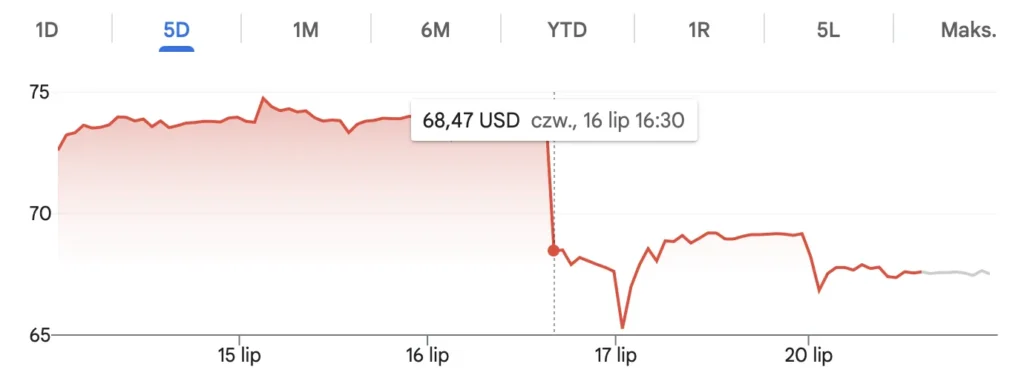
History rhymes on Wall Street. Last Thursday (July 16), Netflix reported its Q2 2026 earnings, delivering solid results that beat Wall Street estimates. However, revenue of $12.56 billion and an EPS of $0.80 couldn’t save the streaming giant from a brutal 9% after-hours sell-off. We saw a similar scenario in April following the Q1 report. Today, a few sessions after this crash, traders and analysts are asking one crucial question: are the current valuations the perfect buying zone, or the beginning of a deeper correction in the VOD industry?
⚡ Q2 2026 Earnings Recap
- Revenue reached $12.56 billion (up 13% YoY). Net income increased to $3.40 billion.
- Earnings per share (EPS) was $0.80, beating the Wall Street median estimate ($0.79) by a cent.
- Despite the beat, shares plummeted due to guidance: the board issued softer outlooks for Q3 and tightened the upper limit of its full-year 2026 revenue target to $51.4 billion.
Why Does “Smart Money” Sell Good Reports?
The reaction to Netflix’s earnings exposes a brutal truth about the current state of the US stock market: tech giants must now completely shatter expectations, not just meet them, to satisfy investors. Netflix showcased a steadily growing business (Q2 hours engaged grew by 2% year-over-year) and a thriving ad-tier segment. Yet, capital ruthlessly moved to close out long positions.
The key to understanding this dynamic is “valuation.” Prior to the report, the company’s stock had been buoyed for months by extremely high multiples. When an asset is priced for perfection, any slight narrowing of future income forecasts acts as a catalyst for supply. Wall Street investors, spooked by increasingly expensive tech valuations, used Thursday’s report as a convenient excuse to lock in profits safely.
“Buying the Dip” or Catching Falling Knives?
For active CFD traders and opportunistic funds (“Buy The Dip” strategies), the gap down on the chart post-Q2 earnings looks extremely tempting. Following last week’s crash, Netflix’s Forward P/E ratio dropped below the S&P 500 average valuation for the first time in over two years.
Indicator tools back this up. While many global institutional funds—such as JPMorgan and Rothschild Redburn—lowered their price targets for the stock after Thursday’s sell-off, the majority still maintain a “Buy” or “Hold” rating. According to some analytical models (like the PEG ratio, which has slipped to 0.65), Netflix has technically become heavily undervalued relative to its intrinsic value and second-half prospects following the recent correction.
On the flip side, there is a lack of a clear short-term bullish catalyst. Netflix’s management informed the markets that they will deliberately reduce the amount of user engagement data shared in upcoming quarters. The absence of hard, quarterly analytical data creates massive uncertainty on the demand side, giving bears room to exert further pressure to close out the massive downward gap on the chart.
Legal Disclaimer: The article above is for informational and educational purposes only. Any opinions and technical analyses presented here do not constitute investment recommendations or financial advice. Investing in financial markets, including equities and derivatives (CFDs), carries a high risk of capital loss. Past financial performance and technical analysis are not guarantees of future results. You make any market decisions at your own risk.