


Will Diesel Prices Fall? G7 Unleashes 100 Million Barrels of Emergency Oil — Here’s the Catch
G7 nations are tapping their strategic reserves. Up to 100 million barrels of crude oil and diesel will hit the market over four months, with a substantial share of diesel within the first 20 days. It is a response to a supply crunch that has sent diesel prices soaring worldwide. But will drivers actually pay less at the pump? The numbers suggest the relief may be shorter than the headlines imply.
⚡ Key numbers:
- 100 million barrels of crude and diesel from G7 reserves, released over 4 months and coordinated by the International Energy Agency (IEA).
- That averages about 830,000 barrels a day, with diesel prioritised in the first 20 days.
- Brent briefly dipped below $100 after the announcement, then recovered to around $102. WTI traded near $90 on Monday.
- US diesel: $6.50 a gallon, up from $5.61 a month earlier and about 70% above pre-war levels.
What did the G7 announce?
On Friday 2 October, French President Emmanuel Macron, whose country holds the G7 presidency, announced a coordinated release of emergency stocks. “We will implement our commitments with a coordinated release through the IEA of 100 million barrels to begin immediately over four months,” the group said. The package also includes higher refinery output and a pledge not to restrict trade in fuels between partner countries.
The deal followed pressure from the Trump administration, which had pushed Europe to draw down reserves faster and threatened to curb US diesel exports. An overnight call between Macron and Trump reportedly sealed the agreement.
Why diesel?
Diesel is the weakest link in today’s fuel market, squeezed by three shocks at once:
- the US-Israel war with Iran disrupting Gulf exports,
- Ukrainian strikes on Russian refineries — Russia, which exported about 783,000 barrels of diesel a day, has dropped out of the market,
- China has stopped exporting diesel.
Will diesel prices fall?
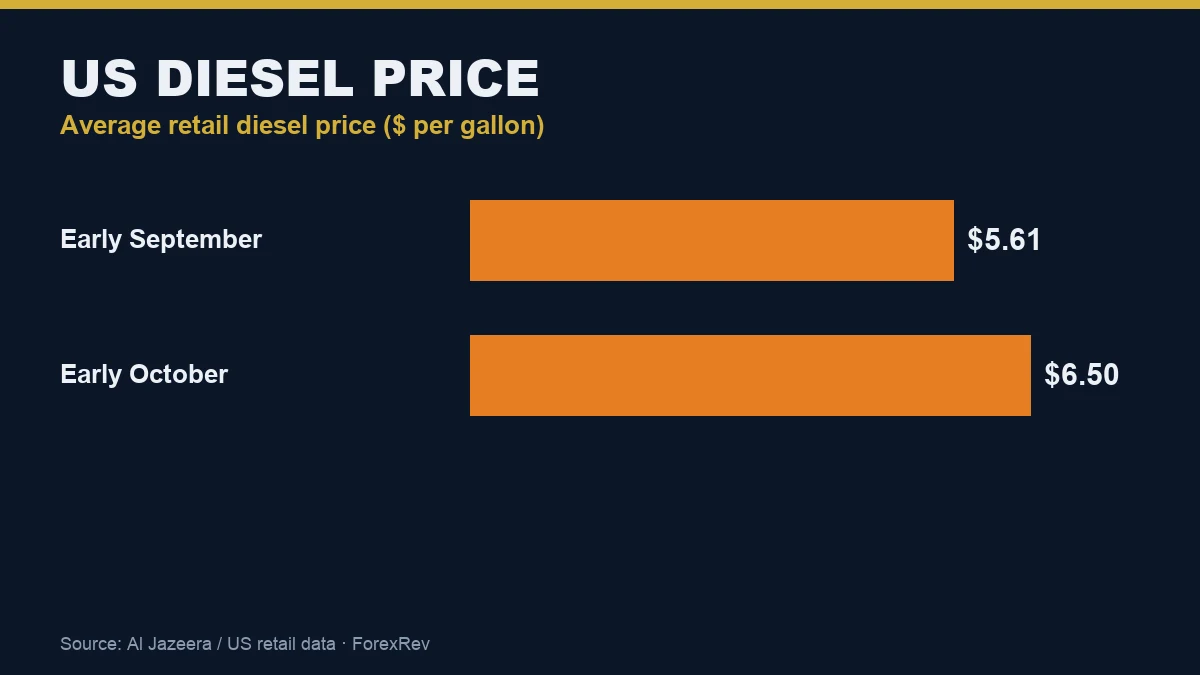
US drivers are paying $6.50 a gallon for diesel, compared with $5.61 a month ago. The release should put some downward pressure on wholesale prices, but pump prices tend to lag, and the scale of the release is modest relative to the shortfall.
Why the relief may be short-lived — the numbers missing from the headlines
100 million barrels sounds huge, but the world consumes roughly 100 million barrels of oil a day. The entire release equals about one day of global demand, spread over four months. And an earlier agreement to release 400 million barrels is only about two-thirds complete.
Economists agree on the direction but not on how long it lasts:
- Hamad Hussain (Capital Economics): the release “will put some downward pressure on prices, particularly global diesel prices. However, the impact would be short-lived.”
- Neil Atkinson (former IEA): the move “doesn’t deal with the fundamental problem that the global supply remains lower than normal.”
There is also a technical catch: strategic crude does not automatically become diesel. It has to go through refineries, and capacity, logistics and crude type decide how much fuel actually reaches the pump.
What it means for markets and traders
The market reaction was jittery: Brent fell below $100 on the news but climbed back to about $102 the same day — a sign that investors see the release as a sticking plaster rather than a cure, with Middle East headlines still in charge. In mid-September Brent was above $105 after the Red Sea escalation.
Levels to watch:
- Brent $100 — a sustained break lower would signal the market believes supply is improving.
- WTI $90 — a test of support after Monday’s drop.
- Inflation expectations — cheaper fuel eases pressure on central banks, which matters for the dollar ahead of Wednesday’s Fed minutes.
If you trade oil via CFDs, compare costs and regulation in our broker ranking.
Frequently asked questions
Will diesel prices fall after the G7 release?
The 100 million barrel release should put some downward pressure on global diesel prices, but economists expect the effect to be short-lived because global supply remains below normal.
How much oil is the G7 releasing?
Up to 100 million barrels of crude oil and diesel over four months, about 830,000 barrels a day on average, with diesel prioritised in the first 20 days.
Why are diesel prices so high in 2026?
The war with Iran is disrupting Gulf exports, Ukrainian strikes have knocked Russian diesel exports off the market and China has stopped exporting diesel.
Disclaimer: This article is informational and is not investment advice. Fuel and commodity prices as of 05.10.2026 may differ by source and region. Trading leveraged CFDs carries a high risk of losing capital.