

Bitget Hacked: $351 Million Stolen, Withdrawals Frozen — Are Your Funds Safe?
One of the world’s largest crypto exchanges has been hit by a hack worth more than $350 million. On Thursday evening attackers drained $351.6 million in XRP, Ethereum and stablecoins from Bitget’s wallets, and the exchange suspended all withdrawals. Management says the loss will be covered in full by its protection fund and that customer funds are safe. For European users there is a second, less publicised issue: Bitget is not in the EU register of MiCA-licensed exchanges.
⚡ The hack at a glance:
- When: Thursday, 24 September 2026, detected at 18:31 UTC.
- How much: $351.6 million from hot and warm (internet-connected) wallets.
- How: a critical backend component was compromised and transaction data forged. According to the exchange, private keys were not leaked.
- Cold wallets: intact, according to Bitget.
- User Protection Fund: over $464 million — about $112 million more than the loss.
- Status: withdrawals suspended with no restart date; trading and deposits remain open.
What was stolen
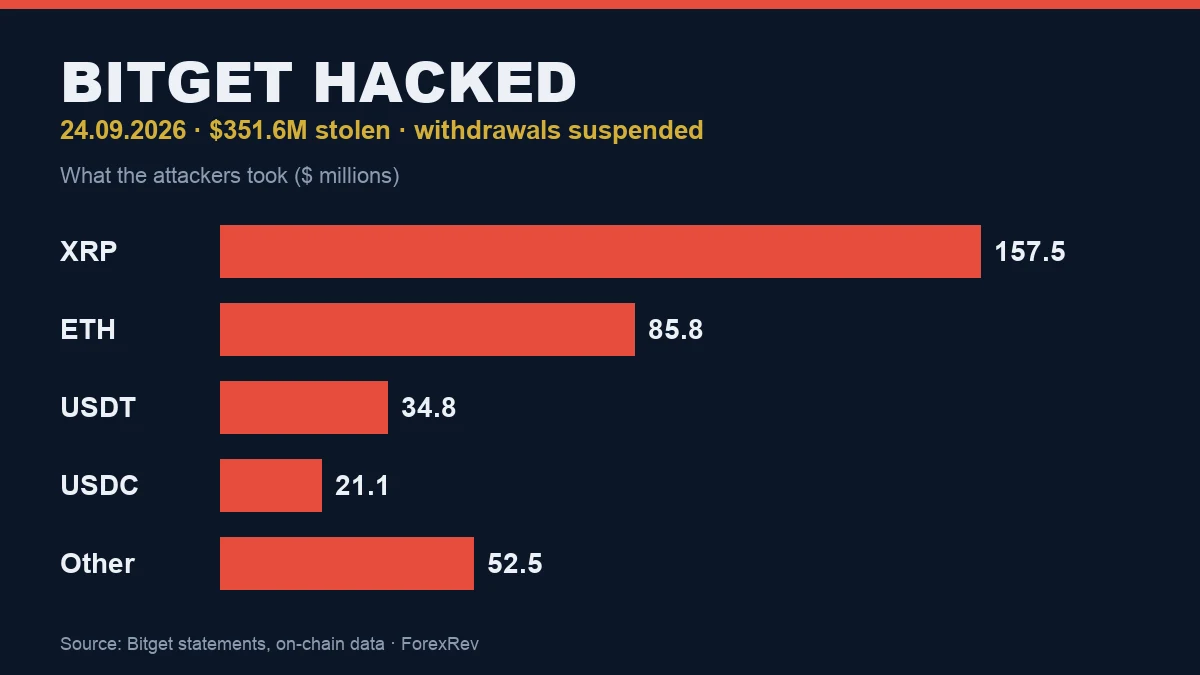
| Asset | Amount | Value |
|---|---|---|
| XRP | 102.93M | ~$157.5M |
| Ethereum (ETH) | 31,890 | ~$85.8M |
| USDT | — | $34.75M |
| USDC | — | $21.05M |
| Other (BNB, AVAX, TRX, XAUt) | — | ~$52.5M |
The split matters for recovery. USDT and USDC (about $56 million combined) can technically be frozen by their issuers if addresses are identified quickly. Ethereum is harder: analysts say the funds have already moved to fresh wallets, the typical first step of laundering. Early data prompted speculation about North Korea’s Lazarus Group. For now that remains an unconfirmed hypothesis.
“User funds are safe” — what that really means
CEO Gracy Chen said on Friday that user funds are safe and the full loss falls within the User Protection Fund. Reassuring, but worth unpacking:
- The fund belongs to the exchange; it is not an independent guarantee scheme like bank deposit insurance.
- After covering this loss, about $112 million will remain — less than a third of its current size.
- No restart date for withdrawals means customers cannot access their money today, even if it is “safe” on paper.
Does Bitget have a MiCA licence?
Bitget is not listed in ESMA’s register of MiCA-authorised providers (as of 11 September 2026). Its European entity, Bitget EU, filed an application with Austria’s FMA on 17 June 2026, two weeks before the end of the transitional period. No decision has been published.
Earlier national VASP registrations in Lithuania, Poland, Bulgaria and the Czech Republic belong to the legacy regime that MiCA replaced. They do not provide the regulation’s protections: asset segregation, capital requirements and a supervisor to complain to. For a comparable, if far more extreme, example of what that means for customers, see our Zondacrypto collapse briefing.
I hold funds on Bitget — what now?
- Do not click “fast withdrawal” links. Every major hack triggers phishing sites impersonating the exchange. Use only Bitget’s official X account and website.
- Screenshot your balance and export your transaction history now, while the dashboard works.
- Check account security: 2FA, withdrawal address whitelist, anti-phishing code.
- Once withdrawals reopen, consider moving funds to your own wallet or to a MiCA-licensed exchange such as Kraken, OKX or Bybit EU. See our exchange ranking and our guide on how to verify a licence.
The bigger picture
The attackers did not steal keys. They fooled the internal authorisation system with forged data, and it approved the withdrawals itself. The lesson for investors is unchanged: crypto held on an exchange is a claim against the exchange, not your property. Do not keep funds you cannot afford to lose on any platform for longer than necessary.
Disclaimer: This article is informational and is not investment or legal advice. Data come from Bitget statements and on-chain analysis available on 26.09.2026 and may change as the investigation progresses. Licensing status per the ESMA register as of 11.09.2026 — check the current register before acting. Crypto investing carries a high risk of loss.