

Oil jumps after deadly Houthi strike on Riyadh: Brent tops $105 as Trump says US ‘may’ join fight
A missile fired by Yemen’s Houthis hit a terminal at Riyadh’s main airport, killing at least 13 people and injuring more than 300 — the deadliest attack on Saudi Arabia in more than a decade. On Monday morning Brent crude pushed above $105 a barrel, and Donald Trump said the US “may” join the fight. At the same time, Washington has reopened the market to Russian diesel. Here is which force is winning — and what it means for oil, fuel prices and the dollar.
⚡ Key numbers:
- At least 13 dead and more than 300 injured after Saturday’s strike on King Khalid International Airport; another projectile on Sunday killed 1 and injured 11.
- Brent: about $105.50 on Monday morning (+0.7%), up from a $102.25 close on October 2. WTI: about $92.50–93.
- April 7, 2027 — the date until which the US has suspended sanctions on Russian diesel (OFAC General License 135).
- US Dollar Index around 102.2; gold near $4,200 an ounce.
- Wednesday, 8:30 a.m. ET — US September CPI, forecast at 3.6% year on year.
What happened in Riyadh?
On Saturday, October 10, a missile struck Terminal 4 of King Khalid International Airport in Riyadh, setting it on fire. Saudi civil aviation authorities initially reported 12 dead and 309 injured; according to NBC News the toll rose to at least 13 after one of the injured died. The victims include nationals of at least eight countries, among them an American. The Saudi-led coalition called the strike a “fully-fledged war crime” and vowed a strong response.
Yemen’s Iran-backed Houthi rebels claimed responsibility and struck again on Sunday — another projectile killed one person and injured 11, and the airport suspended operations. Dammam airport was also targeted on Sunday evening, and the Houthis claimed attacks on Saudi energy facilities. Three people had already been killed in an attack on the same airport on Thursday. Over the weekend two tankers were also attacked, one of them hit by a drone near the Sohar anchorage off Oman.
Trump: “We may”
Asked whether the US would join operations against the Houthis, President Donald Trump said: “We may. We’re gonna look at it,” adding that a decision would come quickly. According to sources cited by NBC News, Crown Prince Mohammed bin Salman urged Trump to take military action as early as September. A renewed Saudi-backed offensive is already under way inside Yemen. Egypt and Qatar condemned the attack, and UN Secretary-General António Guterres blamed the Houthis.
For markets, the message is that the Middle East conflict — which began in late February — is not fading but spreading onto the territory of the world’s largest oil exporter.
Oil: Brent above $105
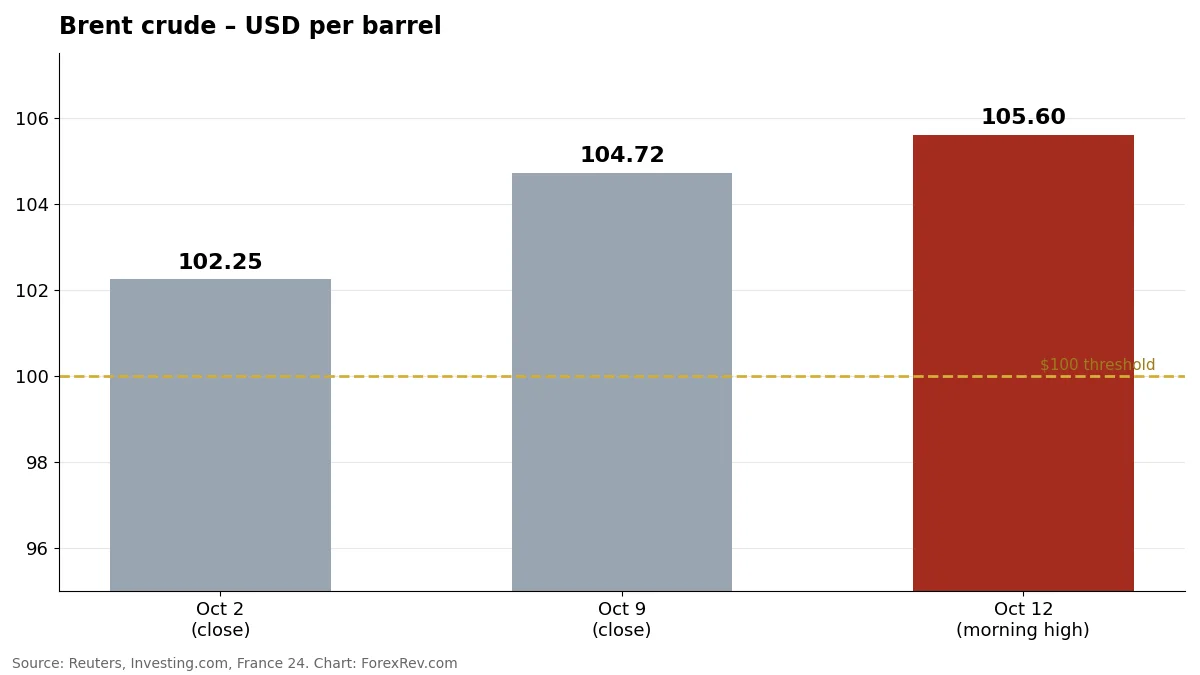
On Monday morning Brent rose about 0.7% to $105.48 a barrel and touched roughly $105.60 at its high; US WTI traded around $92.50–93. As recently as October 2 — the day the G7 announced an emergency stock release — Brent closed at $102.25, so the impact of the G7’s 100 million barrels has proved short-lived.
Traders are pricing in a risk premium: strikes on Saudi airports, claimed attacks on energy infrastructure and fighting around the Bab al-Mandab strait all threaten the routes that carry Gulf crude to Europe. Every new attack on tankers or oil facilities can lift that premium quickly.
The counterweight: Russian diesel returns
There is an opposing force too. On October 9 the US Treasury issued General License 135, which until April 7, 2027 authorises the sale, delivery and import of Russian-origin diesel — including into the United States. The move followed a call between Trump and Vladimir Putin; Trump spoke of more than 4 million tonnes of Russian fuel reaching world markets, although that figure does not appear in the licence itself. Ukraine and lawmakers from both parties in Congress have criticised the decision.
Extra diesel supply could cap pump prices, but it has not yet shown up in futures — on Monday, fear of escalation in the Gulf won out.
Market reaction
Outside oil, markets are calm. The dollar index is holding around 102.2, the euro trades near $1.12 and gold remains around $4,200 an ounce. US index futures are higher, while Asian markets are in the red — South Korea’s KOSPI lost more than 3% in a tech sell-off. The US bond market is closed for Columbus Day; the 10-year Treasury yield ended Friday around 5.24%, close to its highest levels since 2002. Emerging-market currencies feel the pressure of a firm dollar — the Polish zloty weakened to 3.92 per dollar.
What to watch next
- The US decision on joining operations against the Houthis — an announcement could lift the risk premium.
- Further attacks on Saudi oil infrastructure and on tankers in the Gulf and the Red Sea.
- US CPI (Wednesday, 8:30 a.m. ET) — forecast at 3.6% year on year; pricier oil adds fuel to another Fed rate hike.
- Actual flows of Russian diesel under the new licence.
Oil and the dollar are among today’s most volatile assets. If you trade them through CFDs, choose a regulated broker — compare them in our forex broker ranking.
Frequently asked questions
What is the Brent oil price after the Riyadh attack?
On Monday morning, October 12, Brent rose about 0.7% to around $105.50 a barrel and touched roughly $105.60 at its high. WTI traded around $92.50–93.
What happened at Riyadh airport?
On Saturday, October 10, a missile fired by Yemen’s Houthis struck Terminal 4 of King Khalid International Airport in Riyadh, killing at least 13 people and injuring more than 300. Another attack followed on Sunday and the airport suspended operations.
Will Russian diesel lower fuel prices?
The US has suspended sanctions on Russian diesel until April 7, 2027. Extra supply could cap prices, but on Monday oil rose on fears of escalation in the Gulf.
Sources: NBC News, Al Jazeera, France 24, Reuters, Investing.com, US Treasury (OFAC), National Bank of Poland.
Disclaimer: This article is for information purposes only and does not constitute investment advice. Prices as of Monday morning, October 12, 2026 may vary by source. Trading leveraged CFDs carries a high risk of losing money.