

RBA rate hike lifts cash rate to 18-year high of 4.85% as Bullock warns on inflation
The Reserve Bank of Australia delivered an expected RBA rate hike of 25 basis points on Tuesday, pushing the official cash rate to 4.85%. The increase marks an 18-year high as monetary authorities confront stubborn inflation above 4%.
⚡ Key numbers:
- 4.85% – the new official cash rate in Australia
- 4.3% – annual CPI inflation recorded in September
- 6-3 – the policy board vote in favor of tightening
- 5 – total rate increases delivered by the RBA in 2026
Benchmark borrowing costs hit 2008 peak
The Reserve Bank of Australia raised its official cash rate by 25 basis points to 4.85% at its November policy meeting. The decision lifts benchmark interest rates to their highest level since November 2008 and represents the fifth 25-basis-point increase enacted this year, following prior moves in February, March, May, and September.
The decision revealed a split among policymakers, with six members voting to increase borrowing costs while three opted to leave the rate unchanged. Markets sharply reduced the probability of an additional rate rise before Christmas to 12%, though financial derivatives still price a roughly 30% likelihood of another increase by May.
“I know this is not the news that many Australians want to hear, but it is what’s needed to get inflation down”
— Michele Bullock, Governor of the Reserve Bank of Australia (via The Guardian)
Persistent price pressures keep RBA hawkish
Australia continues to grapple with elevated consumer prices. Monthly inflation accelerated to 4.3% in September from 4.0% in August, remaining well above the central bank's 2.0% target. According to updated RBA projections, consumer price inflation will stay elevated through much of 2027 and is not anticipated to drop back into the 2% to 3% target corridor until late 2027.
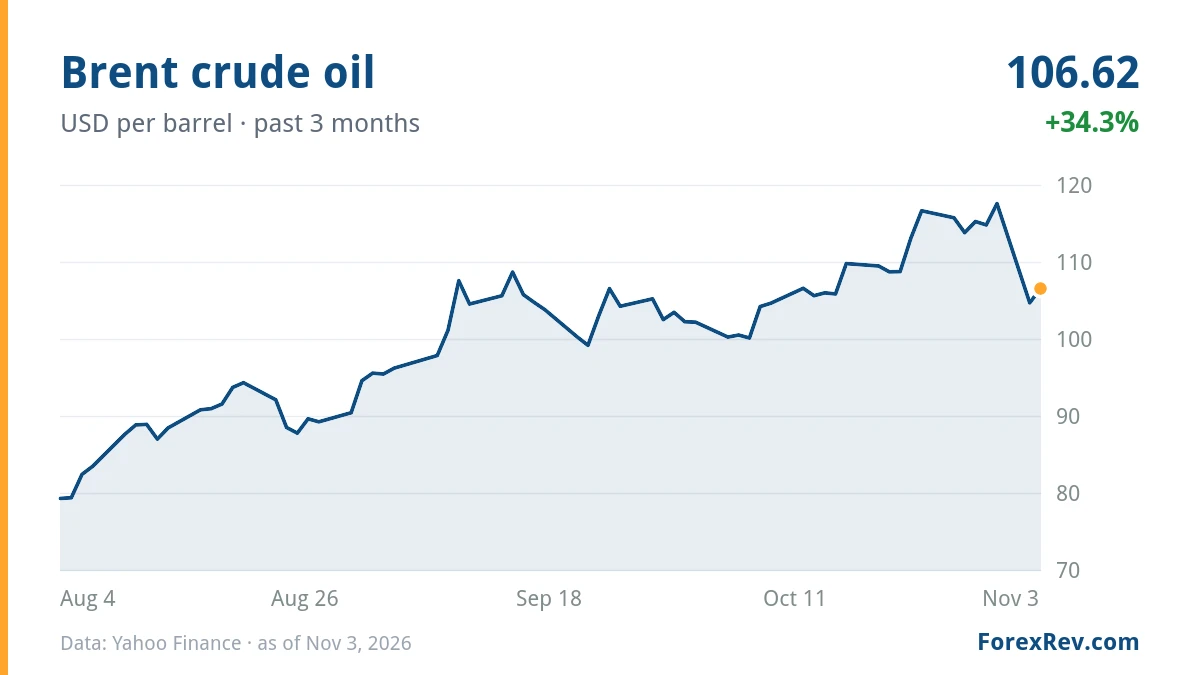
Governor Michelle Bullock highlighted that upside risks to inflation have begun materializing. In September, Bullock pointed to elevated oil prices from the Iran conflict, while the RBA highlighted rising technology costs from artificial intelligence spending. The Australian move comes at a time when major peers are balancing conflicting priorities, as shown when the ECB keeps interest rates unchanged to protect regional activity.
Australian dollar slips as markets weigh growth outlook
Despite the monetary tightening, the Australian dollar weakened across major currency pairs. The AUD/USD pair dropped 0.25% toward 0.6975 as traders reassessed the likelihood of a conditional summer pause. Strategists at Rabobank noted that consumer demand faces rising friction from cumulative rate rises, trimming their medium-term AUD/USD target to 0.72.
Macroeconomic momentum in Australia has tempered over recent quarters, with second-quarter GDP growth moderating to 2.1% year-on-year from 2.5% in the first quarter. While housing conditions remain challenging, the RBA noted that a domestic recession is not its baseline expectation, forecasting unemployment to rise modestly from 4.7% to 4.9% by the end of next year.
Today's decision by the RBA was widely expected, but that doesn't make it any easier for families and businesses.
It's difficult news for many Australians who are already paying a hefty price for circumstances outside their control.
We take responsibility for our part of the…
— Jim Chalmers MP (@JEChalmers) November 3, 2026
What to watch next
- RBA monetary policy communication during the upcoming summer recess
- Australian quarterly consumer price index data releases
- Global energy prices amid geopolitical developments in the Middle East
Frequently asked questions
What is Australia's current cash rate after the RBA rate hike?
The official cash rate sits at 4.85% following a 25-basis-point hike on November 3, 2026, marking its highest level in 18 years.
Why did the Australian dollar drop after interest rates went up?
Investors treated the move as a dovish hike, interpreting central bank comments as an indication that the RBA may pause policy moves over the summer to assess economic pressure.
When does the RBA expect inflation to reach its target band?
The central bank projects inflation will return to its 2% to 3% target range in late 2027, about three quarters later than earlier anticipated.
Sources: Bankier.pl, The Guardian, FXStreet, CNBC, Cointelegraph, Yahoo Finance.
Disclaimer: This article is for information purposes only and does not constitute investment advice. Data as of Nov 3, 2026, 13:25 may vary by source. Trading leveraged CFDs carries a high risk of losing money.
This article contains AI-generated content.