


Brent crude tops $111 as Iran tensions trigger five-month high
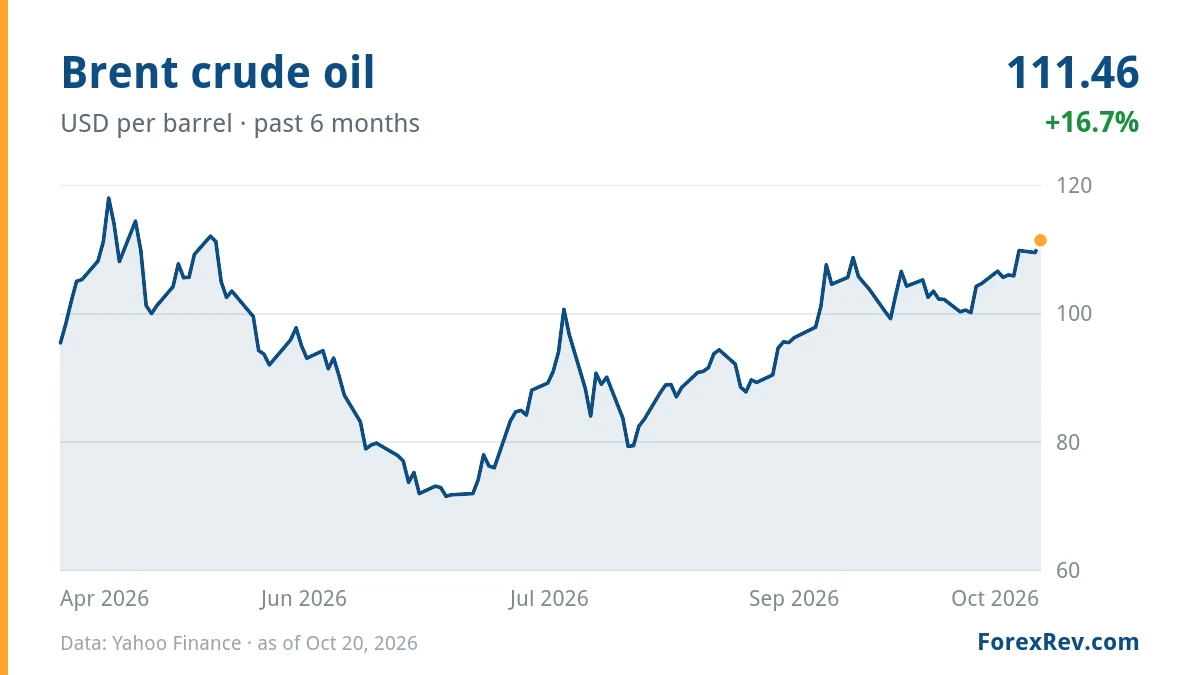
Crude oil jumped to five-month highs on Tuesday as Iran asserted sovereign control over the Strait of Hormuz. Brent pushed past $111 a barrel, widening its premium over WTI and reigniting global concerns over fuel supply disruptions.
⚡ Key numbers:
- $111.46 – Brent crude spot price per barrel
- 80.8% – Brent crude year-to-date gain
- 80% – current Persian Gulf crude flows compared to pre-war volumes
Tehran asserts control over Strait of Hormuz
Crude markets faced renewed supply anxiety after senior Iranian officials hardened their stance on the world’s most critical maritime oil transit corridor. First Vice President Mohammad Reza Aref declared that Tehran has no choice but to exercise sovereign jurisdiction over the waterway, blaming Washington for the instability.
Hamad Hssain, commodities analyst at Capital Economics, warned that stepped-up strikes against merchant vessels could choke off global supplies and send crude higher. The situation weighs on market sentiment, as Middle East tensions immediately translate into higher risk premiums across futures contracts.
“This strait belongs to Iran, and the United States is now the cause of the current situation and must pay the price”
— Mohammad Reza Aref, First Vice President of Iran (via Bankier.pl)
Supply disruptions widen Brent premium
Brent crude advanced to $111.46 a barrel on Tuesday, while US benchmark WTI traded around $100.70. Brent’s roughly $11 premium over WTI illustrates deep nervousness regarding maritime shipping routes and direct exposure to Persian Gulf output.
Market and agency data indicate that Persian Gulf oil shipments are running at roughly 80% of pre-conflict levels. However, refined products remain particularly tight, prompting US officials to lobby European partners to tap their strategic diesel inventories.
Inflation fears weigh on equities
Surging energy costs are beginning to disrupt broader financial markets. In Asia, South Korean equities dropped sharply as the KOSPI tumbled nearly 4%, weighed down by heavyweights Samsung Electronics and SK Hynix amid compounding geopolitical worries.
Rising commodity benchmarks also complicate monetary policy projections. Investors are increasingly cautious that persistent energy inflation may limit central banks' ability to loosen policy in the near term.
What to watch next
- Washington's review of Tehran's proposal to reopen the Strait of Hormuz
- Potential release of strategic diesel reserves coordinated across European capitals
- Energy price transmission into upcoming headline inflation prints
Market volatility brings opportunity, but also risk. If you trade through CFDs, choose a regulated broker — compare them in our forex broker ranking.
Frequently asked questions
Why is Brent crude trading near five-month highs?
Prices are surging due to heightened risks of disruptions in the Strait of Hormuz after Iranian officials asserted sovereign control over the key maritime route.
What is the price spread between Brent and WTI crude?
Brent trades near $111.46 while WTI sits near $100.70, establishing a premium of roughly $11 that reflects acute Middle Eastern supply risks.
Sources: Forsal, CoinDesk, Bankier.pl, money.pl, Yahoo Finance.
Disclaimer: This article is for information purposes only and does not constitute investment advice. Data as of Oct 20, 2026, 13:39 may vary by source. Trading leveraged CFDs carries a high risk of losing money.
This article contains AI-generated content.