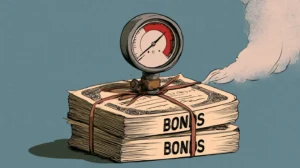



A Ticking Debt Bomb. France and Poland Emerge as the Black Sheep of the European Union
While equity investors on major European indices try to maintain a slow, bullish momentum, the sovereign bond market is flashing bright red warning signs. Debt markets are sounding the alarm over the loss of fiscal stability in key Old Continent economies. Global analysts are now zeroing in on France, which is grappling with a progressive political and fiscal crisis, and Poland, which is currently running one of the highest deficits relative to GDP in the entire European Union. How will the phenomenon of “fiscal dominance” impact FX markets in the coming months?
⚡ Quick Takeaways
- France is facing a severe budget crisis, with 2026 forecasts showing structural deficits remaining well above the EU’s 3% threshold. A destabilized political scene in Paris further complicates any rescue efforts.
- Poland joins the “debt club.” With a deficit exceeding 7% of GDP, the CEE powerhouse has become one of the EU’s most fiscally expansive states, trailing only closely behind Romania.
- Financial markets are demanding increasingly higher yields (risk premiums) on both French OATs and Polish treasuries, drastically raising the debt servicing costs for both nations.
- Forex traders view this surging debt as a bearish fundamental argument. It signals long-term headwinds for both the shared European currency (EUR) and the Polish zloty (PLN).
France: The Sick Man of Europe Returns to the Radar
For the past decade, investors fearing a European sovereign debt crisis focused primarily on the southern states (the so-called PIGS bloc: Portugal, Italy, Greece, Spain). However, in the first half of 2026, market scrutiny has ruthlessly shifted to the Seine. A fragmented political landscape has severely undermined the French government’s ability to implement the painful spending cuts currently necessary to salvage the national budget.
Meanwhile, yields on the French 10-year government bonds (OATs) are climbing relentlessly, and the spread (yield differential) against the safe-haven German Bund is reaching alarming highs. Furthermore, international rating agencies are issuing loud warnings, threatening to downgrade Paris’s sovereign credit rating. For the European Central Bank (ECB) and the broader Eurozone, this is a top-tier risk. Losing fiscal control in the bloc’s second-largest economy hampers coherent monetary policy planning and acts as a heavy anchor on the EUR/USD valuation.
Poland Leading the Race in Debt Generation
A similarly “loose” fiscal path has been taken by Poland, which currently sits at the complete opposite end of the fiscal discipline demanded by Brussels. According to official data, Poland’s fiscal deficit accounts for over 7% of its GDP—a figure that places the country at the absolute tail end of Europe. To make matters worse, Q1 2026 readings indicate that the nominal deficit has already surpassed an astronomical 69 billion PLN, with certain tax revenues even falling into negative territory.
Extensive social welfare programs, massive structural spending on military and defense, and the costs of energy shields have created a system where capital is hemorrhaging at an unprecedented rate. The government is forced to roll over debt and issue record volumes of treasury bonds, exhausting the absorption capacity of the domestic market. The sheer necessity of seeking capital from foreign investors makes Polish debt highly vulnerable to any shifts in global risk sentiment.
Market Implications: How to Trade “Fiscal Dominance”?
A macroeconomic environment where government policy (deficits) virtually forces central banks to maintain specific interest rates is known as fiscal dominance. For the markets, this means the fight against inflation takes a backseat to the pressing need to finance massive state debt.
For active traders on investment platforms, the takeaways are clear. In the case of the Polish zloty, the massive budget deficit creates a “twin deficit” (budget deficit combined with a current account deficit), which historically serves as one of the strongest arguments for fundamental currency depreciation. On the other hand, returning fears over France’s solvency act as a roadblock for European bulls. Macro traders should expect elevated volatility, particularly during periods of upcoming rating reviews (Fitch, S&P, Moody’s) and during the announcement of debt issuance calendars for both nations.