



Two Tankers Catch Fire in Strait of Hormuz as Brent Tests $110
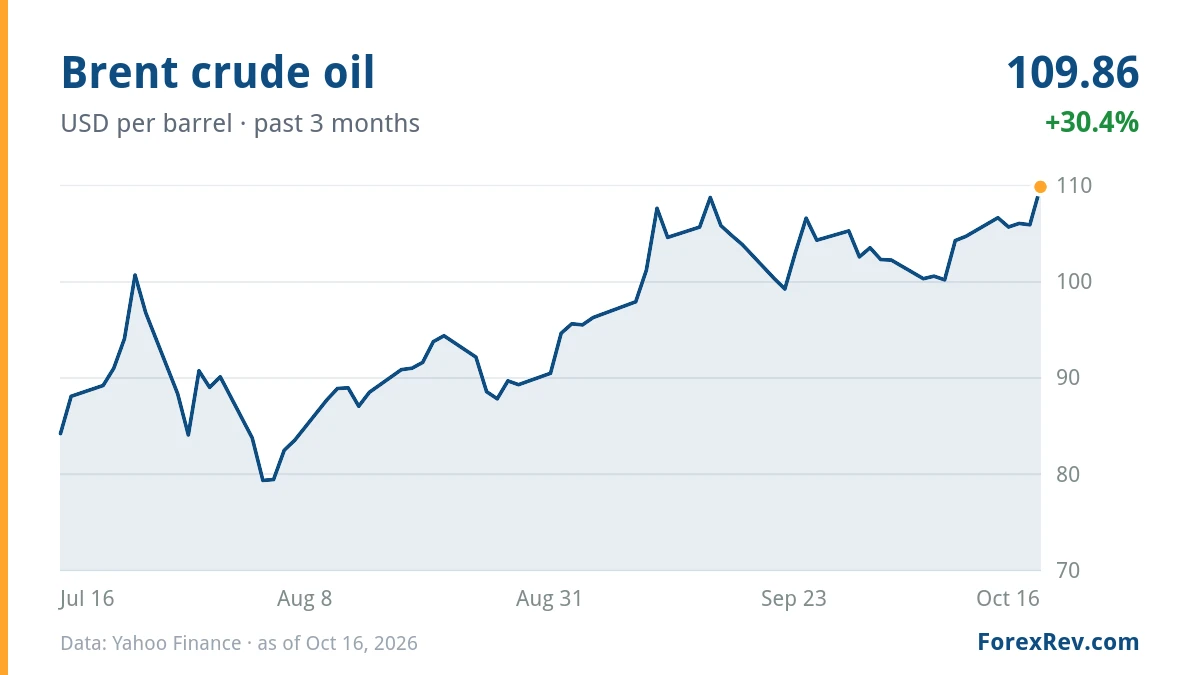
Two supertankers carrying roughly four million barrels of crude oil caught fire in the Strait of Hormuz after hitting naval mines, according to Iran's Islamic Revolutionary Guard Corps. The incident pushed Brent crude toward $110 per barrel as traffic plummeted.
⚡ Key numbers:
- 2 million barrels of crude carried by each stricken vessel
- $110 per barrel hit by Brent crude during Friday trading
- 2.9 million barrels transited on October 11 versus 20.8 million on October 8
- 9 vessels attacked in or near the waterway over the past week
Mine strikes set tankers ablaze in critical chokepoint
Iran's Islamic Revolutionary Guard Corps (IRGC) stated that two oil tankers caught fire in the Strait of Hormuz after striking naval mines. Official news agency IRNA reported that the first vessel suffered an explosion and a fierce blaze, while the second tanker was engulfed in flames shortly after.
According to IRNA, both vessels had disabled their transponders and navigation systems, attempting to navigate a passage unauthorized by Iranian authorities. Tehran claimed one tanker attempted to pass under US military cover while the second vessel remained stranded and immobilized.
Three FALSE Iranian claims in the past 24 hours:
🚫 CLAIM: The IRGC has continued to falsely claim control of the Strait of Hormuz.
✅ FACT: The United States and regional partners control the strait as commercial vessels continue to transit despite unwarranted IRGC… pic.twitter.com/rgpeZ95dvU
— U.S. Central Command (@CENTCOM) October 15, 2026
Oil shipments plummet as shipping security deteriorates
Data from energy intelligence provider Kpler reveals the magnitude of the disruption: crude volumes passing through Hormuz plunged from 20.8 million barrels on October 8 to just 2.9 million barrels on October 11.
For the week ended Wednesday, flows averaged 9.4 million barrels per day, approximately 70% of prewar norms. The International Maritime Organization confirmed that at least nine commercial ships have faced attacks since Sunday, leaving three sailors injured and two missing.
Energy markets react to supply shock fears
Global crude benchmarks spiked sharply on the escalating maritime peril, echoing dynamics seen across recent Red Sea escalations and market reactions. Brent crude rose 3.7% on Friday to settle at $109.86 per barrel after touching an intraday high of $110.
In the United States, average retail gasoline reached $6.33 per gallon, up over 70% from a year ago according to AAA. Concurrently, US crude inventories dropped by more than 8 million barrels in the week to October 9 following hurricane-related production halts.
What to watch next
- US Central Command actions regarding commercial shipping escort operations
- Market open pricing in Asia as energy traders assess mine risks in the Gulf
- Potential geopolitical shifts surrounding the November 3 US midterm elections
Market volatility brings opportunity, but also risk. If you trade through CFDs, choose a regulated broker — compare them in our forex broker ranking.
Frequently asked questions
What happened to the tankers in the Strait of Hormuz?
Two tankers carrying roughly two million barrels of crude each struck naval mines and caught fire after navigating without transponders.
How high did oil prices rise after the attacks?
Brent crude reached an intraday session high of $110 per barrel before settling at $109.86, up 3.7% on Friday.
How much has oil transit dropped through the strait?
Kpler data shows crude transit fell from 20.8 million barrels on October 8 to 2.9 million barrels on October 11.
Sources: Al Jazeera, CNBC, Yahoo Finance.
Disclaimer: This article is for information purposes only and does not constitute investment advice. Data as of Oct 18, 2026, 06:00 may vary by source. Trading leveraged CFDs carries a high risk of losing money.
This article contains AI-generated content.